

The global burden of rheumatic diseases is reaching critical proportions. In 2020, 17.6 million people worldwide were living with rheumatoid arthritis (RA), and this number is projected to surge by a staggering 80.2% to 31.7 million by 2050. In fact, rheumatoid arthritis accounts for roughly 19% of all global immunology clinical trials, highlighting the intense focus on this area.
Rheumatoid arthritis is a chronic autoimmune condition that disproportionately affects women at least twice as often as men, typically emerging between 60 and 70 years of age. The consequences of untreated disease are severe: within a decade, it leads to work disability in 50% of cases and can reduce life expectancy by approximately 12 years. These stark realities underscore the urgent need for continued innovation in rheumatology clinical research.
As the population ages, the stakes grow even higher. Nearly 40% of RA patients are now aged 65 years or older, yet the evidence guiding treatment decisions continues to come from studies that rarely include them . This representation gap is one of the most pressing challenges facing the field today.
Rheumatology trials present unique characteristics that distinguish them from other therapeutic areas and require specialized approaches:
Rheumatoid arthritis is not an acute condition, it requires long-term management and disease modification. Clinical trials in this space often span months or years, demanding sustained patient engagement and meticulous long-term follow-up.
Unlike oncology, where tumor shrinkage or survival are relatively straightforward endpoints, rheumatology relies on composite scores such as DAS28 (Disease Activity Score), ACR20/50/70 response criteria, and patient-reported outcomes (PROs). A review of RA trials from 2013 to 2023 found that ACR20 (24%) and DAS28 (21%) were the most commonly used endpoints, though the use of DAS28 has been increasing . Only 7% of trials adhered to a “treat-to-target” strategy, and the most commonly used outcome measures often did not align with guideline recommendations.[3]
Effective rheumatology trials must integrate multiple data streams:
Strategic trial design and execution require careful attention to several critical factors:
with trials often spanning years, patient retention is paramount. Incorporating patient-reported outcomes, flexible visit schedules, and strategies to minimize participant burden can significantly improve retention rates. Recent research suggests that expectation of concrete disease improvement and personal endorsement by one’s treating rheumatologist are among the strongest drivers of patient participation, rather than simply reducing medical mistrust.
biomarkers are increasingly essential as indicators of disease activity and predictors of treatment response. Integrating biomarkers into trial design can enhance patient stratification and enable more precise assessment of therapeutic efficacy.
proper incorporation and measurement of standardized metrics (DAS28, CDAI, SDAI) is critical. As the field moves toward more stringent and sensitive clinical endpoints, ensuring these measures are consistently applied and interpreted correctly is essential for generating reliable data .
the persistent underrepresentation of older adults, who make up nearly 40% of RA patients, remains a significant blind spot. A comprehensive systematic review of 514 randomized controlled trials across seven autoimmune rheumatic diseases found that over half of RCTs (56%) imposed an upper age limit, most often excluding adults older than 70 years. Only one-third of studies explicitly reported data on older adults. Ensuring diverse and representative patient populations is essential for generalizable results.
сhoosing sites with experienced investigators and access to relevant patient populations is critical. Regions with established rheumatology networks and high-quality investigative sites can significantly accelerate recruitment and improve data quality.
Despite advances in therapeutics, rheumatology trials face persistent challenges:
Rheumatoid arthritis is not a uniform disease, it presents with wide variability in symptoms, disease activity, and progression. This heterogeneity complicates patient stratification and can confound treatment effect assessments.
Trials often span months or years, demanding sustained patient engagement. Maintaining high retention rates over extended periods requires proactive patient retention strategies and careful management of participant burden.
Navigating international regulatory requirements across multiple countries adds significant complexity to rheumatology trials. Each region may have different expectations regarding trial design, endpoint selection, and safety monitoring.
Rheumatology trials generate large volumes of diverse data – imaging, biomarkers, clinical assessments, and patient-reported outcomes. Integrating and managing this data effectively requires robust data management systems and biostatistical expertise.
Between 2013 and 2023, 425 RA interventional trials were registered on ClinicalTrials.gov, but trial numbers have been declining. Excessive industry sponsorship and delayed publication of results were also noted as concerns .
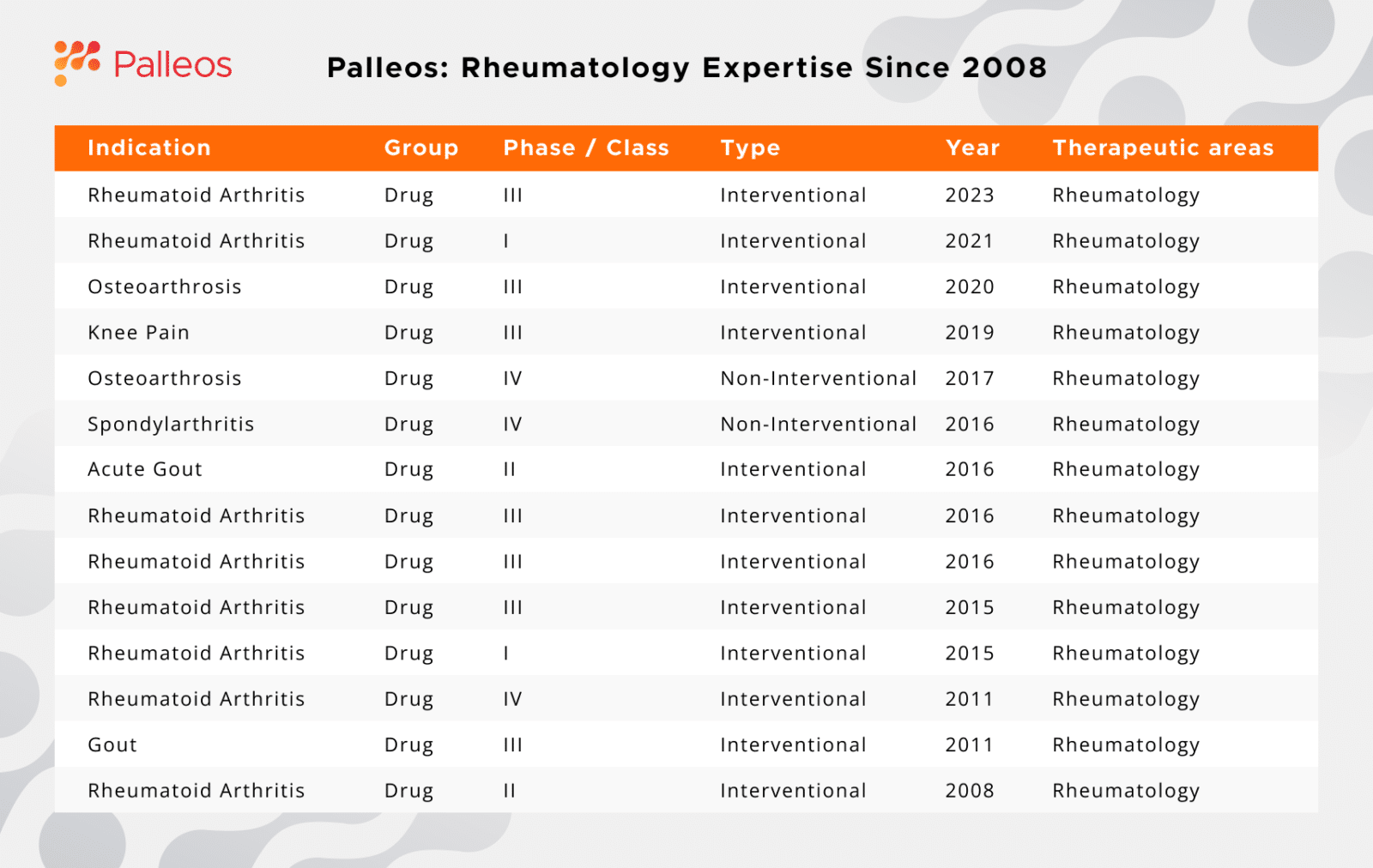
With over two decades of experience, Palleos has established itself as a trusted partner in rheumatology clinical research. Since 2005, Palleos has successfully completed over 420 clinical trials across 29 therapeutic areas, demonstrating deep expertise in managing trials from Phase I through IV. With a strong focus on rheumatology, Palleos has conducted 24 rheumatology studies spanning multiple indications including Rheumatoid Arthritis, Osteoarthritis, Knee Pain, Spondylarthritis, and Acute Gout, covering a wide range of phases (I–IV) and study types, both interventional and non-interventional, which showcases the company’s versatility and depth of experience. Headquartered in Germany and with a strong presence in Central and Eastern Europe, Palleos offers access to high-quality investigative sites and experienced investigators across 18 countries; this regional expertise is particularly valuable for navigating the complex regulatory landscape and accelerating recruitment timelines. Palleos has also demonstrated resilience and capability even in challenging circumstances, successfully completing a Phase 2b rheumatology study in three countries despite global lockdowns and achieving recruitment targets and regulatory approvals against all odds. The company’s rheumatology portfolio includes studies across various indications, from early-phase exploratory trials to large-scale Phase III confirmatory studies and post-marketing non-interventional studies, demonstrating comprehensive capabilities across the drug development continuum. This diverse portfolio and proven track record position Palleos as a reliable partner for pharmaceutical companies and biotech firms seeking to navigate the complexities of rheumatology drug development.
The statistics are clear: rheumatology clinical research stands at a critical juncture, with the projected surge in RA cases to 31.7 million by 2050 demanding continued innovation and investment in therapeutic development. However, the path forward requires addressing persistent challenges: the underrepresentation of older adults, declining trial numbers, and the complexity of outcome measurement. Success in this landscape demands specialized expertise, strategic trial design, and a deep understanding of both clinical and regulatory nuances. Organizations that can effectively navigate these complexities, like Palleos with its 24 rheumatology studies and 420+ completed projects, are well-positioned to drive the next wave of therapeutic breakthroughs. By leveraging regional expertise, patient-centered approaches, and robust operational capabilities, the clinical research community can address the growing burden of rheumatic diseases and improve outcomes for millions of patients worldwide.
If you’re ready to move from challenges to solutions and accelerate your rheumatology program, our team of experts is here to help. Visit our contact page to discuss your specific trial needs and discover how we can support your next project.